Mercedes-Benz has long been associated with smooth, powerful and technologically advanced engines. From efficient four-cylinder units to sophisticated inline-six engines and muscular V8s, the company offers different powertrains for very different types of drivers. But what actually separates a Mercedes-Benz four-cylinder from a six-cylinder or V8?
The answer is not simply power. Cylinder count affects performance, refinement, fuel consumption, weight, sound, complexity and even the character of the car. Mercedes-Benz continues to offer combustion engines ranging from four to eight cylinders, increasingly combining them with 48-volt mild-hybrid or plug-in hybrid technology.
Four-Cylinder Engines: Efficiency and Everyday Performance
Four-cylinder engines are the most common choice for Mercedes-Benz models designed around efficiency, practicality and accessible performance. Modern Mercedes four-cylinder engines are generally turbocharged and can produce considerably more power than older naturally aspirated engines of similar size.
The biggest advantage is efficiency. A smaller engine generally has lower internal friction and reduced weight, while turbocharging allows it to produce strong torque without requiring a large displacement. Electrification can further improve responsiveness and efficiency. For example, Mercedes-Benz’s latest CLA generation uses a 48-volt electrified four-cylinder engine paired with an eight-speed dual-clutch transmission.
A four-cylinder Mercedes can therefore feel surprisingly quick in normal driving. Turbocharging provides substantial low- and mid-range torque, making the engine suitable for city driving, motorway cruising and everyday acceleration.
However, there is a trade-off. Even with extensive balancing technology, a four-cylinder typically cannot match the inherent smoothness of a six- or eight-cylinder engine. Under heavy acceleration, it may also sound less refined and feel busier.
For buyers who prioritize fuel economy, lower running costs and sufficient performance for everyday driving, the four-cylinder is often the most practical configuration.
Six-Cylinder Engines: The Balance Between Efficiency and Luxury
Six-cylinder engines occupy an interesting middle ground. They offer more refinement and power than a four-cylinder while generally consuming less fuel than a comparable V8.
Mercedes-Benz has traditionally favored the inline-six configuration for many of its larger and more sophisticated models. The modern M256 EVO, for example, is a 3.0-liter turbocharged inline-six used in vehicles such as the Mercedes-AMG GLE 53. In that application, it produces 330 kW (449 hp), with up to 600 Nm of torque, and is supported by electrification.
One of the greatest strengths of an inline-six is its inherent mechanical balance. The cylinders can be arranged so that primary and secondary forces are naturally well balanced, contributing to the smoothness Mercedes-Benz customers expect from a luxury vehicle.
Six-cylinder engines also tend to provide a more effortless feeling when accelerating. Instead of needing to work hard to move a large vehicle, a six-cylinder can deliver strong torque with relatively little effort.
For many drivers, the six-cylinder represents a compromise between the efficiency of a four-cylinder and the performance and character of a V8. It is particularly well suited to larger sedans and SUVs where refinement is just as important as outright acceleration.
Eight-Cylinder Engines: Performance and Character
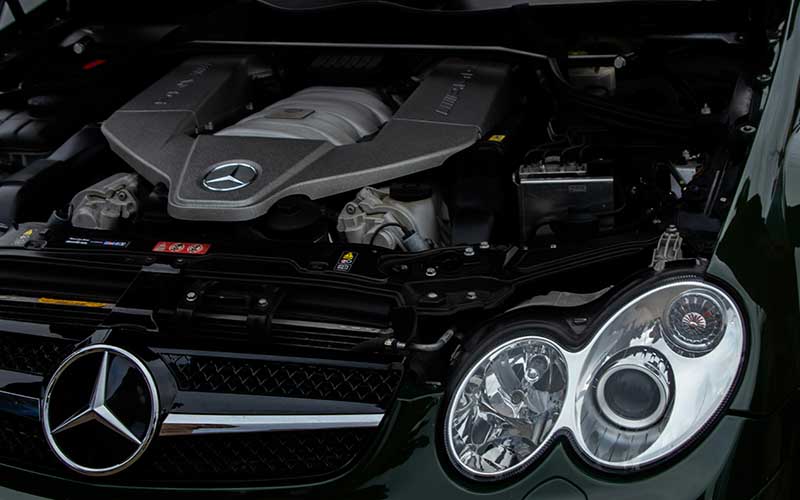
The V8 remains one of the most recognizable performance-engine configurations in the Mercedes-Benz range. Although modern regulations and electrification have pushed manufacturers toward smaller engines, Mercedes-AMG continues to develop and use V8 technology in its high-performance models.
The current 4.0-liter AMG M177 EVO V8 demonstrates how far modern V8 technology has progressed. In the latest GLE 63 S and GLS 63, it produces 450 kW (612 hp) and 850 Nm of torque. A 48-volt integrated starter-generator can provide additional electrical assistance, while other updates improve response and efficiency.
The main advantage of the V8 is effortless performance. With eight cylinders producing power, the engine can deliver enormous torque while remaining remarkably smooth. It also produces a distinctive exhaust note that has become an important part of the AMG experience.
The disadvantages are equally clear. A V8 is generally heavier, more mechanically complex and more fuel-intensive than a smaller engine. It can also cost more to manufacture and maintain.
Nevertheless, for performance-oriented drivers, the V8 offers something that numbers alone cannot fully describe: engine character. Mercedes-AMG itself describes the V8 as a central part of its performance identity.
Which Engine Is Right for You?
There is no universally superior cylinder configuration. Each has a different purpose.
A four-cylinder makes the most sense for drivers who prioritize efficiency, affordability and everyday usability. Modern turbocharging and hybrid technology mean that a four-cylinder Mercedes can still provide impressive performance.
A six-cylinder is suited to someone who wants a more luxurious and effortless driving experience without moving all the way to a V8. Its combination of smoothness, torque and reasonable efficiency makes it an attractive choice for larger Mercedes-Benz models.
An eight-cylinder is aimed more toward drivers who value maximum performance, engine character and the traditional AMG experience. Fuel economy becomes less important than power, response and emotional appeal.
The Future of Mercedes-Benz Engines
Mercedes-Benz is clearly moving toward greater electrification, but combustion engines have not disappeared. The company says it has a range of electrified combustion engines from four to eight cylinders designed to meet future emissions requirements.
The interesting part is that the traditional advantages of larger engines are increasingly being supplemented by electric assistance. Mild-hybrid systems can provide additional torque at low engine speeds, improve stop-start operation and recover energy during braking. This allows smaller engines to deliver performance that previously required greater displacement.
Ultimately, choosing between a Mercedes-Benz four-, six- or eight-cylinder engine comes down to priorities. The four-cylinder emphasizes efficiency, the six-cylinder balances refinement and performance, while the V8 emphasizes power and character. Modern technology has narrowed the performance gap between them, but each configuration still gives a Mercedes-Benz a distinctly different personality.