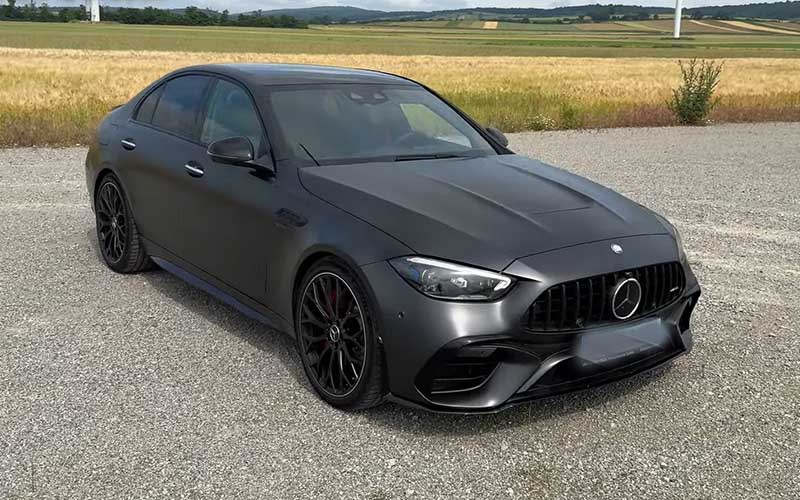
The latest Mercedes-AMG C63 S E Performance may be one of the most controversial performance sedans of the decade. For over fifteen years, the C63 badge represented something simple and glorious: a compact luxury sedan powered by a thunderous V8 engine. The newest generation abandons that formula entirely, replacing it with a highly complex plug-in hybrid system built around a turbocharged four-cylinder engine and an electric motor. The result is a car that is objectively faster, more technologically advanced, and arguably more capable than any C63 before it. Whether it is a better AMG, however, is a much more complicated question.
On paper, the numbers are staggering. The hybrid powertrain produces 671 horsepower and 752 lb-ft of torque, making this the most powerful C-Class ever built. Mercedes claims a 0-60 mph time of around three seconds, and independent testing has confirmed that figure. In a straight line, the C63 feels genuinely explosive, delivering instant electric torque combined with relentless turbocharged acceleration. It launches with the urgency of an EV and continues pulling hard well into triple-digit speeds.
The technology behind the performance is impressive. AMG borrowed concepts directly from its Formula 1 hybrid program, integrating a rear-mounted electric motor, a two-speed transmission for the electric drive unit, and a sophisticated battery system designed for power delivery rather than extended electric range. From an engineering perspective, the C63 is a remarkable achievement and showcases just how far performance hybrids have evolved.
Yet the car’s greatest strength is also its biggest weakness.
The previous C63 models were beloved because they felt visceral and emotional. Their naturally aspirated and later twin-turbocharged V8 engines delivered a soundtrack that turned every drive into an occasion. The new four-cylinder simply cannot replicate that experience. Despite artificial sound enhancement and AMG’s efforts to inject drama into the cabin, the engine lacks the depth, character, and theatre that defined earlier generations. Many enthusiasts view this as a fundamental loss rather than a simple change in specification.
Weight is another challenge. At roughly 4,800 pounds, the new C63 is dramatically heavier than both its predecessor and key rivals such as the BMW M3 Competition. Mercedes has done an admirable job disguising that mass with rear-wheel steering, adaptive suspension, and sophisticated all-wheel drive systems, but physics remains physics. The car is astonishingly quick, yet it never feels as playful or agile as the best sports sedans in the segment. On smooth roads, the chassis delivers immense grip and confidence. On rougher surfaces, however, the weight becomes more noticeable, affecting composure and driver engagement.
Inside, the C63 largely excels. The cabin is modern, luxurious, and packed with technology. The latest MBUX infotainment system is visually impressive, the materials feel appropriately premium, and the sports seats provide excellent support. Ambient lighting, digital displays, and AMG-specific performance menus reinforce the car’s high-tech identity. Some controls, particularly the touch-sensitive steering wheel buttons, can be frustrating to use, but overall the interior remains one of the strongest aspects of the package.
Interestingly, public reaction to the car has been almost as fascinating as the vehicle itself. Among automotive journalists and AMG loyalists, criticism has often centered on the loss of the V8 and the car’s increased complexity. Online owner discussions reveal a more nuanced picture. While many enthusiasts still prefer older V8-powered models, some owners praise the new C63’s incredible acceleration, daily comfort, and advanced technology. The debate highlights a broader question facing performance brands today: should they prioritize emotion or technical excellence?
Ultimately, the Mercedes-AMG C63 S E Performance is neither a failure nor an unquestioned success. It is a fascinating machine that demonstrates what modern performance engineering can achieve. It is faster than ever, packed with cutting-edge technology, and capable of supercar-rivaling acceleration. At the same time, it sacrifices some of the raw personality that made previous C63s legendary.
Viewed purely as a performance sedan, the latest C63 is immensely capable. Viewed as the successor to one of AMG’s most beloved icons, it feels like a car still searching for its identity. That tension is what makes it such an intriguing—and divisive—automobile.